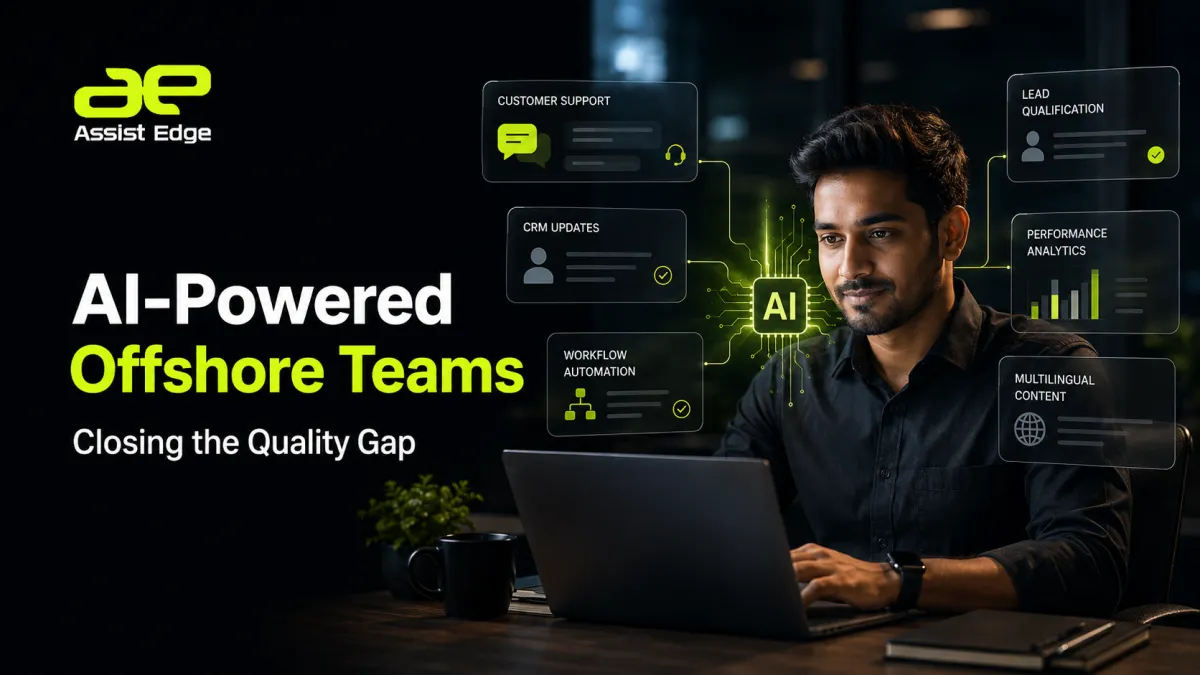
AI-Powered Offshore Teams: Quality at Lower Cost
How AI-Powered Offshore Teams Close the Quality Gap
How AI-Powered Offshore Teams Close the Quality Gap
Why do offshore teams experience a quality gap?
How do AI-powered offshore teams improve productivity?
Can AI improve offshore customer service quality?
How does the model enable 24/7 premium support?
Where can AI improve offshore lead generation?
What can cause an AI-powered offshore model to fail?
AI-powered offshore teams combine skilled professionals with intelligent assistants, automation, and real-time knowledge systems. This model helps offshore agents work more consistently, resolve tasks faster, support customers around the clock, and deliver work that better matches onshore standards without recreating the full cost structure of an internal team.
For years, companies have treated offshore staffing as a simple trade-off: accept lower costs but prepare for uneven quality, slower training, or communication problems. That assumption is becoming outdated.
The stronger model is not automation replacing offshore professionals. It is technology making those professionals more capable. AI can provide immediate access to procedures, draft responses, summarize conversations, check work, translate content, and recommend the next action. Human agents still supply judgment, empathy, accountability, and market awareness.
Why do offshore teams experience a quality gap?
The offshore quality gap usually comes from differences in context rather than a lack of talent. Onshore employees may learn informally by attending meetings, observing senior colleagues, and asking quick questions. With structured onboarding and documented offshore team workflows, businesses can give agents clearer responsibilities, system access, training, and performance expectations.
This creates predictable problems:
Knowledge is scattered across different systems.
Procedures become outdated.
New agents take longer to reach full productivity.
Tone and terminology vary between employees.
Quality checks happen after work is completed.
Small uncertainties turn into unnecessary escalations.
An AI-powered knowledge assistant can make approved instructions, examples, policies, and customer information available during the task. Instead of relying on memory or waiting for a supervisor, agents receive relevant guidance when they need it. This reduces variation while helping new employees learn through real work.
How do AI-powered offshore teams improve productivity?
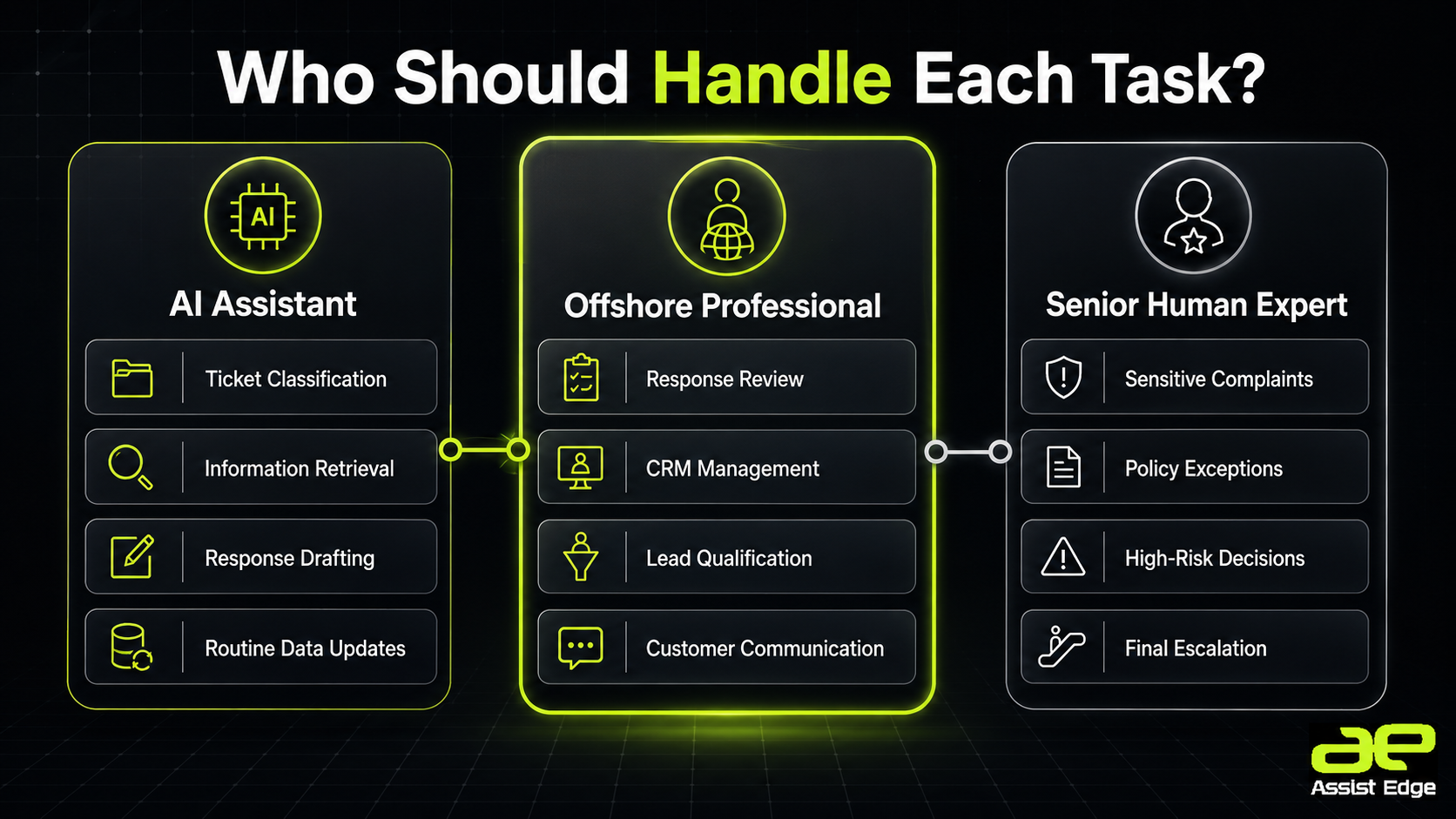
AI-powered offshore teams improve productivity by reducing the administrative work surrounding each task.A customer-service agent may use AI to summarize a long ticket, identify the customer’s main issue, retrieve the correct procedure, draft a response, and complete routine tasks such as CRM updates and administrative management.
The agent then reviews the information, corrects any errors, and makes the final decision.
This approach matters because productivity is not simply about working faster. It includes reducing repeated effort, limiting avoidable mistakes, and helping employees spend more time on tasks that require human attention.
AI can assist offshore professionals with:
Call and meeting summaries
Response drafting
CRM data entry
Quality-control checklists
Knowledge retrieval
Automated task classification, lead routing, and follow-up workflows
Sentiment and urgency detection
These capabilities are particularly valuable for new agents. AI can act as an always-available support layer that reinforces training without forcing supervisors to answer the same procedural questions repeatedly.
Can AI improve offshore customer service quality?
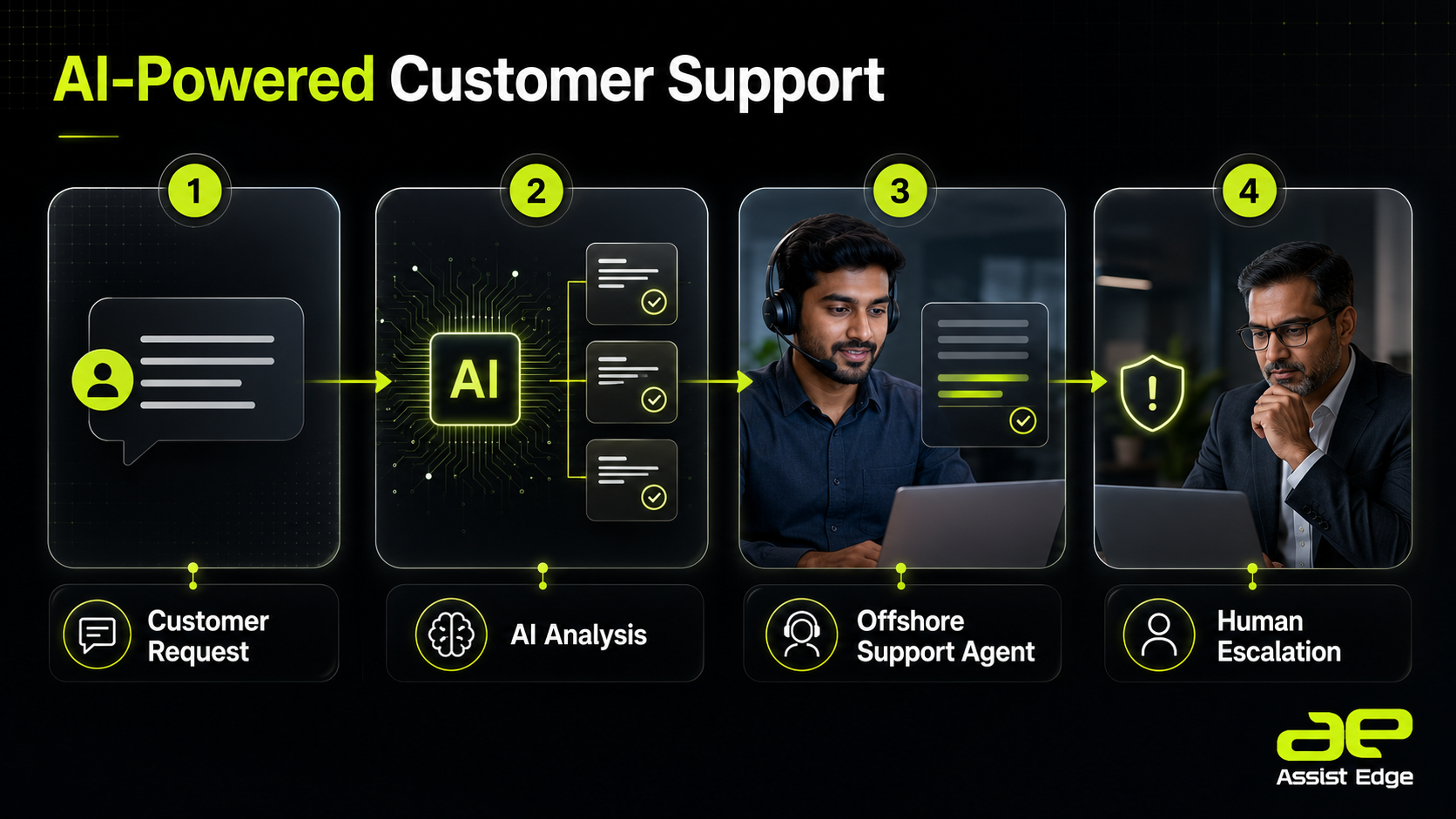
AI can improve offshore customer service when it supports trained agents instead of blocking customers from reaching a person. The technology can handle straightforward requests, prepare agents before conversations, recommend relevant answers, and summarize interactions after they finish.
A practical support model separates work into three levels:
This structure prevents a common failure: forcing automation to handle situations it cannot reliably understand.
Companies should define when the assistant may answer automatically, when an agent must approve its response, and when the issue must move to a senior employee. Clear escalation rules protect both efficiency and customer trust.
How does the model enable 24/7 premium support?
Round-the-clock support becomes more practical when offshore schedules, automated systems, and human coverage work together. AI assistants can respond to routine questions, collect information, create tickets, and identify urgent cases outside normal business hours.
Offshore professionals working across time zones can then manage conversations that need judgment or personal attention.
Premium 24/7 support does not mean pretending a bot is a human. It means designing a continuous service operation in which customers receive immediate acknowledgement, simple requests are resolved quickly, and complicated cases reach a qualified person.
To maintain quality, businesses should establish response-time targets, ownership rules, shift handovers, escalation contacts, and service-level reporting. They should also review customer satisfaction, resolution quality, repeat-contact rates, and escalation accuracy rather than measuring ticket volume alone.
Where can AI improve offshore lead generation?
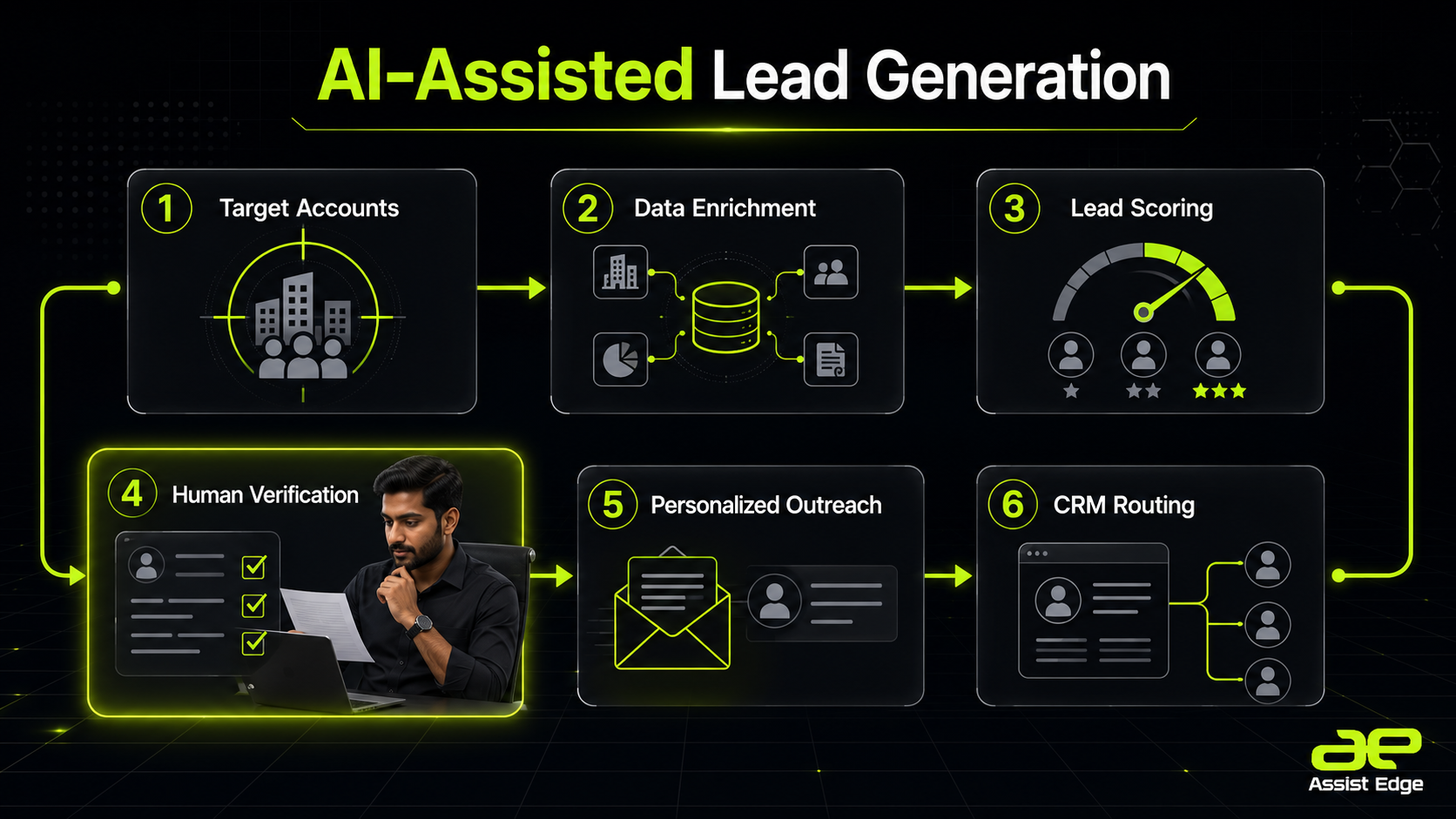
AI can strengthen offshore lead generation by helping teams research, prioritize, enrich, and route prospects through structured CRM and lead-routing automation. An offshore specialist might review target accounts while an AI assistant summarizes company information, identifies potential buying signals, and prepares a personalized outreach draft.
The human specialist verifies the information and decides whether the prospect is relevant.
A responsible workflow may include:
Define the ideal customer profile.
Collect information from permitted sources.
Enrich and validate business records.
Score prospects using transparent criteria.
Draft personalized outreach.
Review messages before sending.
record responses and update the CRM.
Route qualified opportunities to sales.
The primary advantage is focus. Agents can spend less time copying information and more time checking fit, understanding context, and creating relevant conversations. Businesses must still respect privacy requirements, platform rules, consent standards, and applicable outreach laws.
Can offshore teams create genuinely localized content?
AI makes first-draft translation and content adaptation faster, but translation alone is not localization. Localized content must reflect regional language, buyer expectations, cultural references, measurements, offers, and legal requirements.
A strong workflow starts with an approved source document and brand glossary. AI creates a regional draft, while an offshore content marketing specialist reviews tone, terminology, factual accuracy, brand consistency, and cultural fit. A native or market-qualified reviewer should approve important campaign, legal, healthcare, or financial content.
This process allows one content team to serve several markets while maintaining clearer brand controls. It can support landing pages, email campaigns, product descriptions, help documentation, social content, and customer-service templates.
The human review stage remains essential because AI can produce fluent wording that is culturally inappropriate or factually wrong.
What can cause an AI-powered offshore model to fail?
AI will magnify weak operations if it is introduced without reliable information or clear ownership. An assistant trained on outdated documents can produce incorrect answers faster than a poorly trained employee.
Common risks include:
Inaccurate or outdated knowledge
Exposure of sensitive information
Unapproved tools or data transfers
Overreliance on generated answers
Poor escalation design
Weak performance measurements
Lack of agent training
No record of automated decisions
Businesses should start with a controlled process, restrict system permissions, require human approval for sensitive actions, and audit a sample of outputs regularly. Agents also need permission to challenge the assistant rather than assuming every recommendation is correct.
Conclusion
AI-powered offshore teams offer a practical way to narrow differences between offshore and onshore performance. AI can distribute knowledge, reinforce training, reduce repetitive work, improve availability, and support more consistent customer communication.
The sustainable advantage comes from combining efficient technology with capable people. Companies still need documented procedures, secure systems, human review, coaching, and meaningful quality measurements.
If you are evaluating managed offshore staffing services, begin with one measurable workflow such as customer support, lead qualification, CRM management, workflow automation, or localized content. Establish a baseline, introduce AI assistance under human supervision, and compare speed, quality, customer outcomes, and total operating cost before expanding the model.
Assist Edge also has a case studies page. However, I would only add this internal link after confirming that the published results, client statements, and performance figures are genuine and properly documented.
Ready to Build an AI-Powered Offshore Team?
Identify the repetitive tasks slowing down your business and discover where skilled offshore professionals, workflow automation, and structured quality control can make the greatest impact.
Book a free 30-minute offshore staffing consultation with Assist Edge to discuss your workflows, staffing requirements, schedule, and business goals.
FAQs
1. Do AI assistants really make offshore agents more productive?
Yes, particularly when agents handle knowledge-intensive or repetitive customer interactions. The NBER research on generative AI at work found that AI assistance increased customer-support productivity by nearly 14 percent on average. Gains were substantially greater among less-experienced workers, suggesting that AI can help transfer practical knowledge from stronger performers to newer agents.
2. Will AI replace offshore virtual assistants?
AI will automate parts of a virtual assistant’s workload, but many roles still require judgment, accountability, relationship management, and exception handling. The more practical model is task redistribution. AI handles retrieval, summaries, drafts, classification, and repetitive updates, while the virtual assistant reviews information, manages stakeholders, and makes context-sensitive decisions.
3. Are AI-powered offshore teams cheaper than onshore employees?
They can have a lower total operating cost, but the result depends on location, role complexity, software expenses, management requirements, security, and quality-control needs. Businesses should compare the complete cost per successful outcome rather than salaries alone. AI infrastructure, integrations, supervision, and compliance processes must be included in the calculation.
4. How can AI help train offshore employees?
AI can turn approved procedures, examples, scripts, and internal documentation into searchable, task-level guidance. Agents can ask questions during their work, receive relevant instructions, and practice difficult scenarios. Managers should monitor these answers, correct inaccurate guidance, and update the underlying knowledge base as policies or client requirements change.
5. Can an AI-enabled offshore team provide 24/7 support?
Yes. Automated assistants can handle simple requests and collect information continuously, while offshore agents provide human coverage across different time zones. Effective 24/7 support still requires planned shifts, handover procedures, escalation contacts, response-time standards, and senior coverage for sensitive or high-impact situations.
6. Which offshore tasks are best suited to AI assistance?
Strong starting points include customer-service summaries, response drafting, CRM updates, lead enrichment, appointment coordination, document classification, quality checks, and first-draft localization. Tasks involving legal decisions, large payments, sensitive complaints, safety, or confidential data should have stricter permissions and qualified human approval.
7. How can businesses measure offshore service quality?
Businesses should measure accuracy, first-contact resolution, customer satisfaction, repeat-contact rates, escalation accuracy, response time, rework, and compliance. Productivity metrics should not stand alone. An agent who closes more tickets but provides incorrect information may increase downstream costs and damage customer trust.
8. Is AI-generated localization reliable?
It is useful for first drafts, terminology suggestions, and content adaptation, but it should not be treated as final approval. A human reviewer should check cultural meaning, regional terminology, facts, brand voice, offers, measurements, and regulatory language. High-risk content should be reviewed by a native or professionally qualified specialist.
9. Does research suggest AI will transform jobs or eliminate them?
Both outcomes are possible, depending on the occupation and implementation. However, the ILO’s refined global analysis of generative AI and jobs concludes that job transformation is the most likely overall effect because most occupations contain a combination of automatable and human-dependent tasks.
10. How should a company start building an AI-powered offshore team?
Choose one documented, repeatable workflow with measurable outcomes. Record the current cost, speed, error rate, and customer impact. Introduce AI assistance with limited permissions, train the offshore agents, create escalation rules, and review results for several weeks. Expand only after the workflow demonstrates reliable quality and acceptable risk.